Real production data for real production decisions.
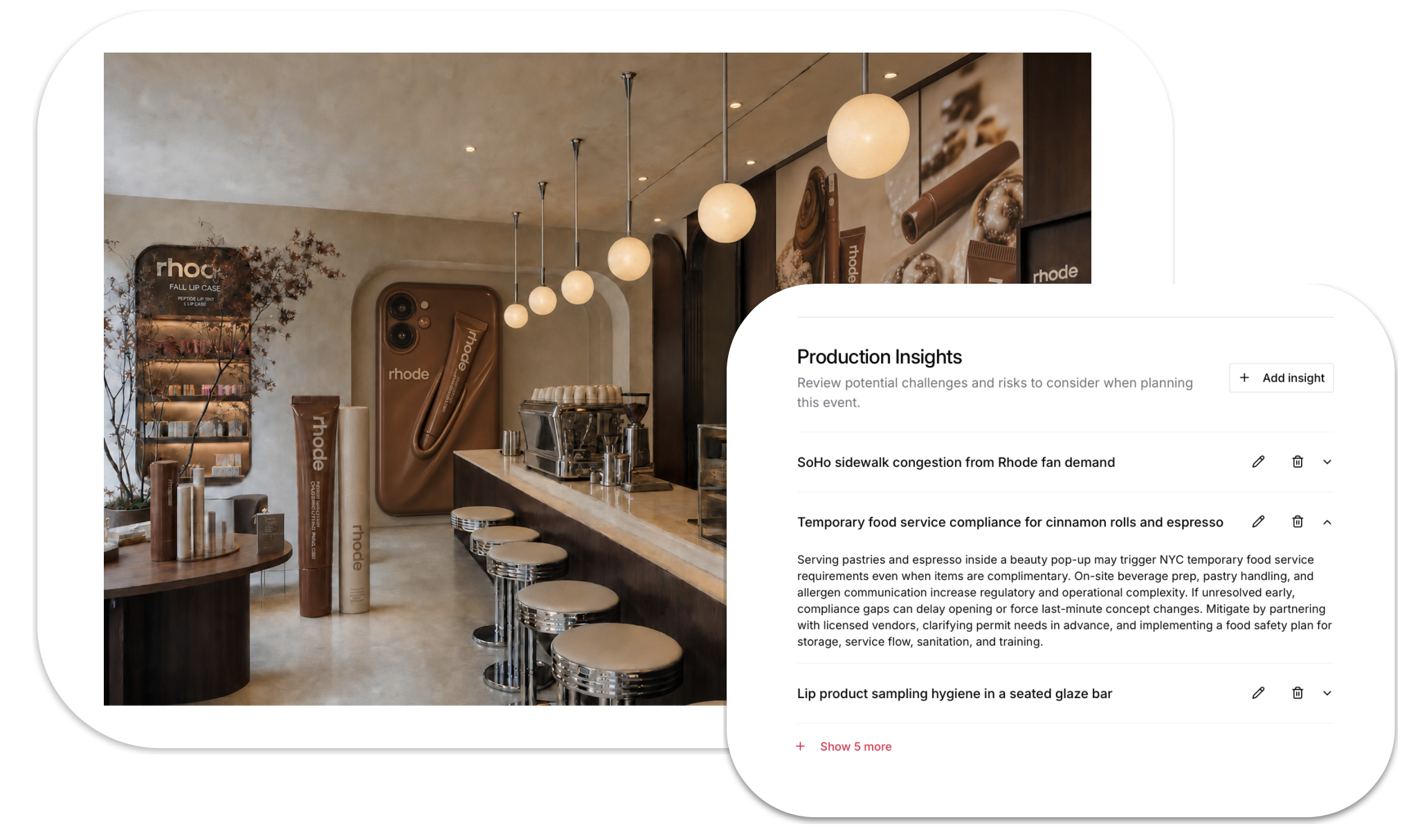
Every production consideration, backed by real production data across the global experience economy. Game-changer.
-
Why does production intelligence matter before a single vendor is contracted?
Production is where strategy meets reality — and where the gap between what was planned and what was built becomes expensive, visible, and very difficult to close. The average experiential activation loses significant budget to production decisions made without real benchmarks — overbuying in categories where the market rate is lower, underbudgeting in categories where it is not, and discovering both too late to course-correct without cost.
BX/D's Production Insights layer exists to close that gap before contracts are signed. Every production decision your team makes — venue selection, fabrication approach, AV scope, staffing ratios, catering parameters, run-of-show structure — is informed by real production data from comparable activations across the experience economy. Not industry averages pulled from a whitepaper. Actual production outcomes from actual programs at actual scale, accumulated across five years of OOO placements and brand partnerships.
The result is a production team that walks into every vendor conversation knowing what things should cost, what timelines are realistic, what scope creep looks like before it happens, and what decisions made at the brief stage will most directly affect the production experience three months from now. Production intelligence does not just save money. It saves the production.
-
Why does location change everything — and how does BX/D account for it?
A production that works in New York does not automatically work in Austin. The vendor landscape is different. The permitting requirements are different. The labor market is different. The cultural context is different. The logistical constraints are different. And the audience expectations — shaped by what they have experienced before in that market — are different.
Most production teams discover these differences the hard way, through conversations with local vendors that surface constraints the brief never accounted for, permit timelines that compress the production schedule, or labor costs that blow a budget built on assumptions from a different market.
BX/D's location-specific data layer surfaces those variables before they become surprises. For every market your activation is entering, BX/D provides real production intelligence specific to that geography — local vendor availability, permitting requirements and timelines, labor market rates, venue capacity benchmarks, logistical constraints, and historical performance data from comparable activations in that city and region.
For brands and agencies running multi-market programs, this layer is the difference between a production plan that accounts for each market's actual conditions and a single plan that assumes all markets are the same. They are not. BX/D knows the difference — and makes sure your production team does too before the schedule is locked.
-
How does BX/D find the right vendors for a specific project — and what makes that different from a standard vendor search?
Finding vendors is easy. Finding the right vendor — the one whose capacity, track record, pricing structure, and working style fit your specific project, your specific market, and your specific brief — is where most production teams spend more time than any other single activity in the pre-production phase.
BX/D's vendor matching works the same way its talent matching does — intelligently rather than alphabetically. Every vendor in the BX/D network is vetted, rated, and indexed against real project outcomes. When your brief is generated, BX/D maps your production requirements against the vendor network and surfaces recommendations matched to your scope, your geography, your budget, your timeline, and your brand's specific production history.
The vendors who surface at the top of your list are not the ones who happened to appear in a Google search or who have the largest marketing budget. They are the ones whose track record on comparable activations, in comparable markets, at comparable scale, makes them the most likely fit for yours. Vendor relationships that used to take a production team weeks to source, qualify, and rate are surfaced in hours — with the intelligence to back every recommendation.
For brands accessing BX/D directly for the first time, vendor matching also eliminates the agency relationship that has traditionally been the gateway to the best production partners. The vendors who delivered on the world's most iconic experiences are in the BX/D network. You do not need an agency to reach them.
-
Why does production need a system that tells you when something is about to go wrong — before it does?
Every production team has a story about the thing nobody caught until it was too late. The permit that was not submitted in time. The venue that could not accommodate the load-in schedule. The vendor whose insurance did not meet the client's requirements. The budget line that was approved at the brief stage but was never realistic for the scope it was supposed to cover.
These are not failures of talent or attention. They are failures of visibility — moments where the right information existed somewhere in the process but was not surfaced to the right person at the right time.
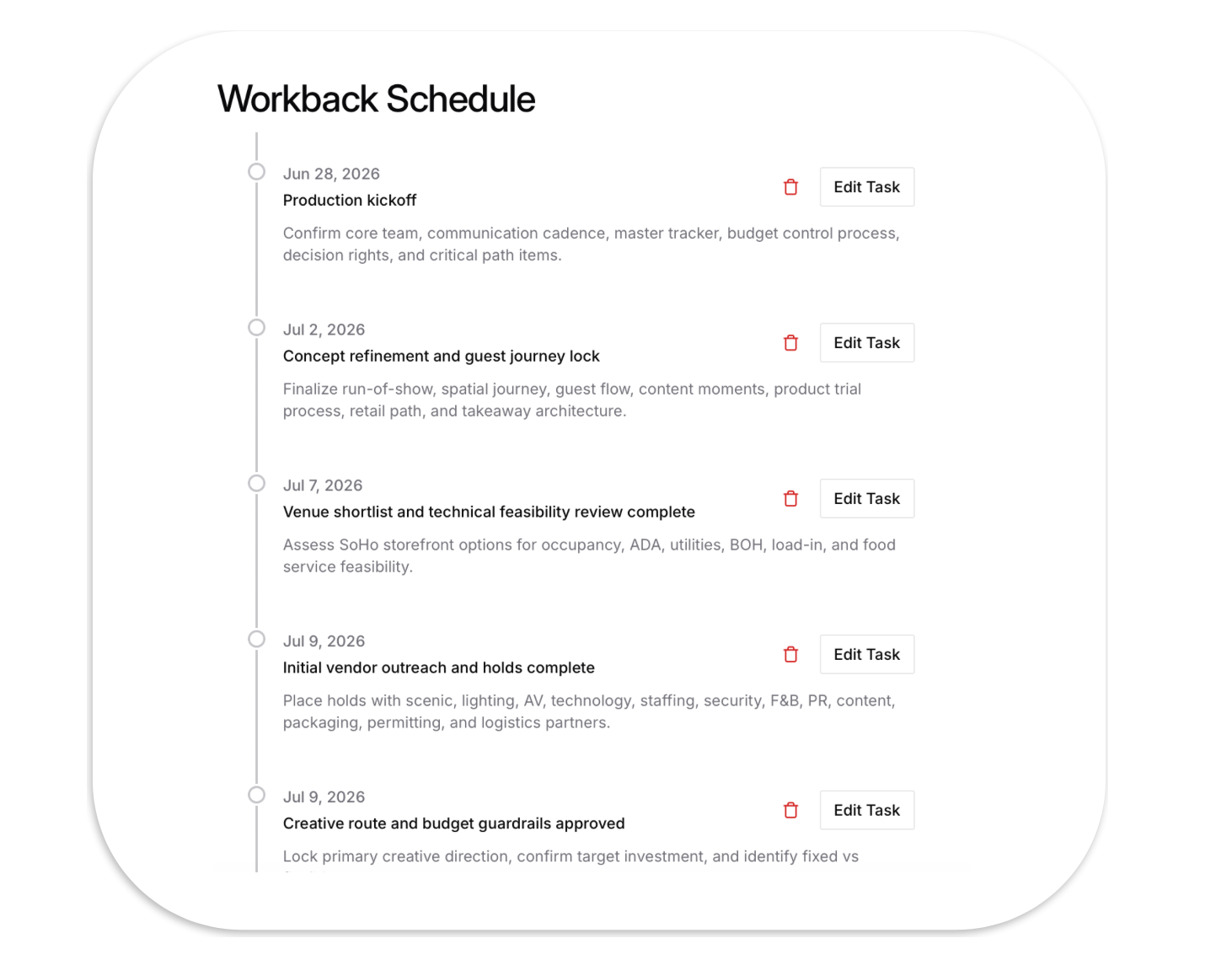
BX/D's Guardrails & Flags layer is a real-time monitoring system for production risk. As your project builds inside BX/D — brief, strategy, talent, vendors, timeline, budget — the platform continuously evaluates the plan against the conditions it is entering and flags the variables most likely to create problems before production is locked.
Permit timelines that conflict with your load-in schedule. Budget allocations that production benchmarks identify as insufficient for the contracted scope. Vendor selections that have historically underperformed on comparable briefs. Talent combinations that have created logistical conflicts on similar programs. Timing decisions that put your activation in direct competition with events that will affect venue availability, vendor capacity, or audience attention.
None of these flags are absolute verdicts. They are early warnings — the system surfacing the conversations your production team needs to have now rather than the week before the event. Every flag comes with the context that generated it and the recommended resolution. The goal is not to restrict production decisions. It is to make sure the people making them have everything they need to make them well.
-
How does BX/D make sure the budget approved at the brief stage is the budget that actually produces the activation?
The single most consistent source of production stress in the experience industry is the gap between the budget that was approved and the budget that production actually requires. That gap almost always originates at the brief stage — where budget parameters are set against incomplete production intelligence, aspirational scope, or assumptions borrowed from a different market, a different scale, or a different era.
By the time the gap surfaces — usually during vendor contracting or mid-production when scope has expanded to match the brief's ambition — the options for closing it are expensive, disruptive, and rarely invisible to the client.
BX/D's Budget Alignment layer attacks that gap at the source. From the moment a brief is generated, BX/D benchmarks the stated budget against real production costs for comparable activations — by scope, by market, by format, by talent requirement, and by vendor category. Every line of the budget is evaluated against what it actually costs to deliver that line at the level the brief is asking for.
Where the budget is sufficient, the team knows and can commit with confidence. Where it is insufficient, the platform surfaces the specific categories where the gap is largest, the scope decisions that would bring the budget into alignment, and the reallocation options that would produce the best outcome within the existing parameters.
The goal is a production budget that arrives at vendor contracting already calibrated to market reality — so the production team is negotiating from knowledge rather than discovering constraints mid-process. A budget aligned at the brief stage is a production that does not get redesigned in the middle of it.