Pressure test cultural fit, market alignment, and behavioral signals before a single dollar is spent.
BX/D surfaces what instinct and 100+ hours of research cannot — the cultural windows, competitive conditions, and behavioral signals that determine whether your activation lands or disappears. All of it before production begins.-
Why does it matter how well your activation idea aligns with the market before you build it?
Most activations fail not because the idea was bad but because the timing was wrong, the market was oversaturated, or the concept landed in a cultural moment it was never designed for. By the time those misalignments become visible they have already cost significant time, budget, and organizational credibility.
The AlignIQ Intelligence Score exists to surface those misalignments before production begins. Every activation concept receives a composite intelligence score that evaluates how well the idea fits the current market landscape — measuring the strength of the concept against real-time industry data, cultural momentum, audience readiness, and competitive activity simultaneously. Not one factor in isolation. All of them together, weighted against each other, producing a single score that tells your team — and your stakeholders — how strong this idea is before anyone commits to building it.
The score does not replace creative judgment. It informs it. A high AlignIQ score means the market is ready for this concept, the timing is right, and the conditions for success are in place. A lower score does not mean the idea is wrong — it means the strategy needs refinement, the timing needs adjustment, or the positioning needs to shift. Either way, your team knows before the budget is approved rather than after the activation ships.
-
Why do some activations become cultural moments while others disappear the week they run?
Timing is not a soft creative consideration. It is the single most underestimated strategic variable in experiential marketing. The same concept executed in the right cultural window generates earned media, social amplification, and audience resonance that can extend its impact for months. The same concept executed two weeks later, against a competing cultural moment your team did not see coming, generates noise and disappointment.
BX/D's Real-Time Cultural Calendar maps the cultural landscape your activation is entering — sporting events, music and entertainment releases, social moments, industry milestones, competitive brand activity, seasonal patterns, and emerging cultural conversations — across the specific time window your program is planned for. It does not just show you what is happening. It shows you what that means for your activation — where the white space is, where the competition for audience attention is highest, and which windows give your concept the best conditions to land.
The result is a brief that accounts for the world your activation will actually enter, not the hypothetical world it was designed for in a conference room three months before launch.
-
What does it mean to get a verdict on your activation before you build it?
Every brief reaches a moment where the team needs to make a call — is this the right concept, the right timing, the right approach — and that call is almost always made on instinct, experience, and the confidence of whoever is most senior in the room. That is not a bad system. It is just an incomplete one.
The Activation Verdict synthesizes everything BX/D knows about your concept — the AlignIQ score, the cultural calendar analysis, the audience fit, the competitive landscape, and the strategic scoring — into a clear, direct recommendation. Go. Refine. Reconsider. Each verdict is accompanied by the specific reasoning behind it and the precise recommendations that would strengthen the concept if refinement is needed.
This is not a system that replaces the creative team's judgment. It is a system that gives that judgment something to push against — a second opinion grounded in real industry data rather than internal consensus. The strongest creative decisions are the ones that have been tested before they are committed to. The Activation Verdict is that test.
-
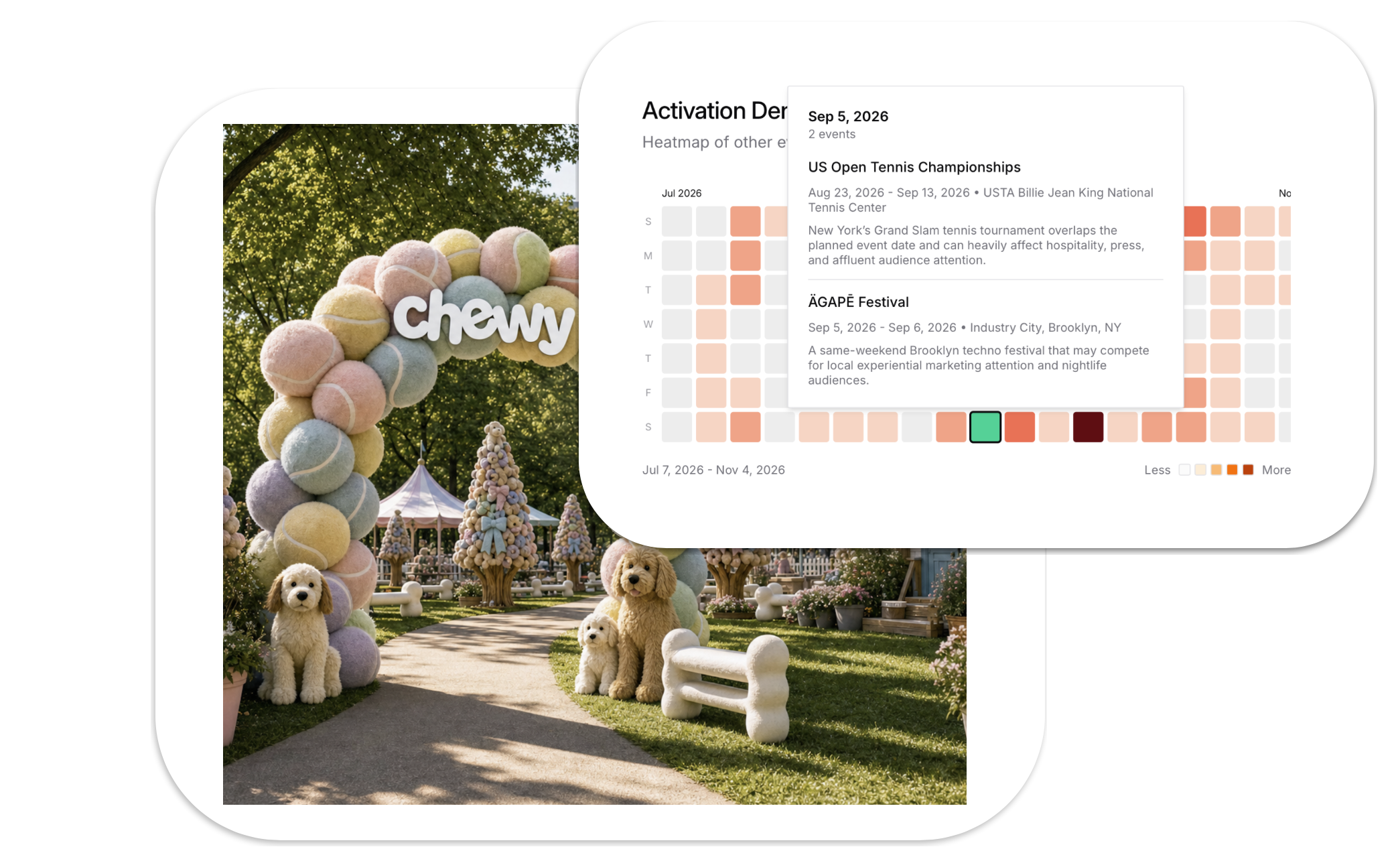
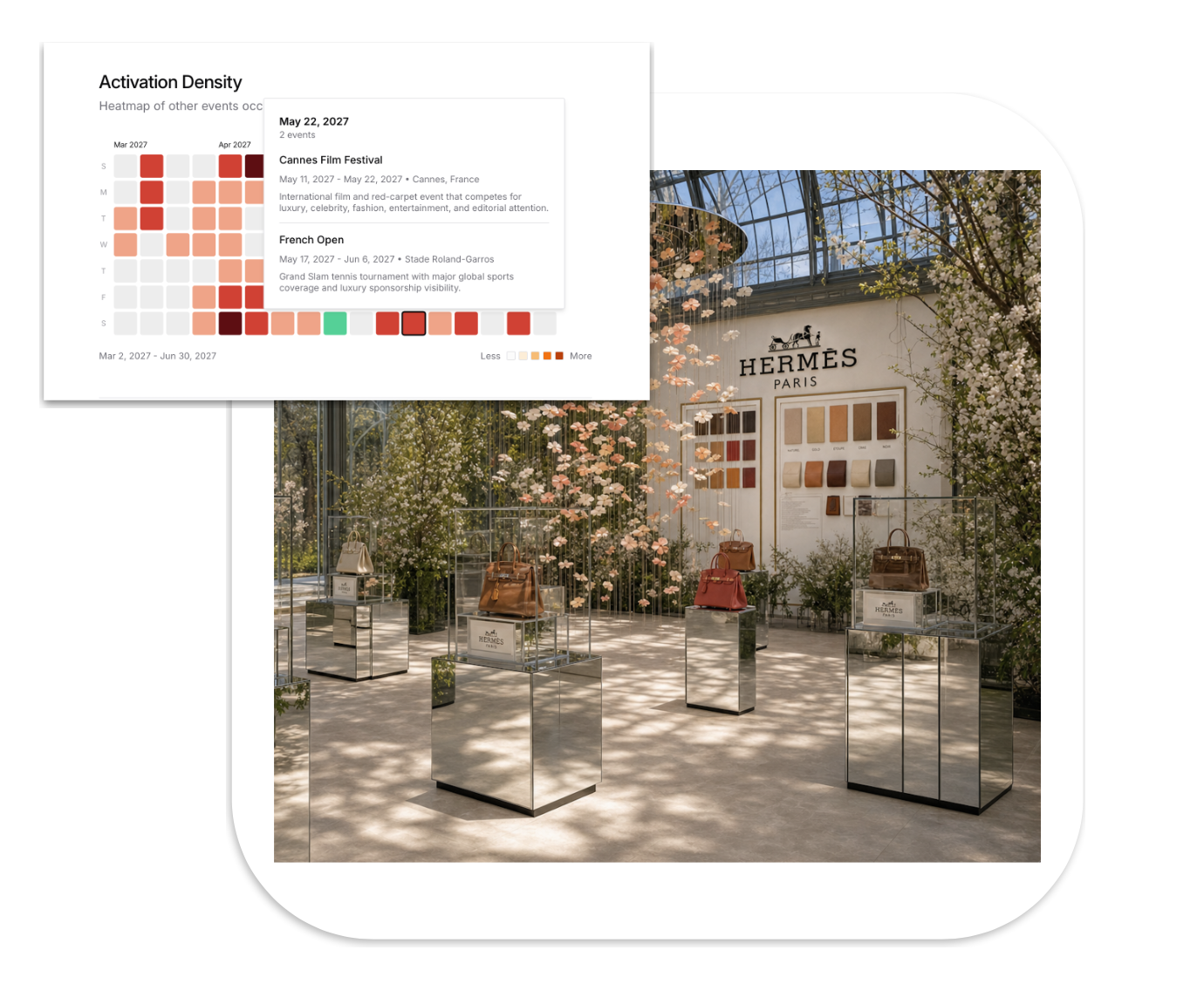
Why does it matter how many other activations are happening in the same space at the same time as yours?
Audience attention is finite. When three brands in the same category run major experiential programs in the same city during the same two-week window, all three underperform relative to what any one of them would have achieved alone. This is activation density — the concentration of competitive experiential activity in a specific market, category, or time window — and it is one of the most consistently overlooked variables in experiential planning.
BX/D's Density Analysis maps the activation landscape your program is entering across geography, category, timing, and audience overlap. It tells you not just that other activations are happening but how much of your audience's attention they are competing for, how similar their formats and positioning are to yours, and whether the window you have selected gives your program room to breathe or drops it into a marketplace already crowded with competing claims on the same audience.
The practical outcome is a planning decision made with real competitive context rather than assumed open market conditions. Sometimes density analysis confirms that your window is clear and your market position is strong. Sometimes it surfaces a two-week adjustment that doubles your earned media potential. Either answer is more valuable than the assumption.
-
How do you know your activation concept is right for the specific market you are entering?
A concept that works brilliantly in New York does not automatically work in Los Angeles. A format that resonates with a Chicago audience at a winter event has different conditions to navigate than the same format in Miami in July. Markets have distinct cultural rhythms, audience behaviors, competitive landscapes, and experiential histories — and an activation concept that ignores those distinctions produces results that confuse teams who assumed the idea was strong and cannot understand why the numbers did not reflect it.
BX/D's Market Alignment Score evaluates your activation concept against the specific market you are entering — city, region, demographic concentration, cultural context, and historical performance data from comparable activations in that market. It tells you how well your concept fits this audience in this place at this time — and where the gaps between your concept and your market conditions are large enough to warrant adjustment before production begins.
For brands and agencies running multi-market programs, the Market Alignment Score becomes the tool that explains why the same concept should be calibrated differently in each market — and what those calibrations should be — rather than the post-mortem that explains why results varied across markets after the program ran.
-
Why does every activation need a document the entire organization can align around before a dollar is spent?
The most expensive moment in experiential marketing is not production. It is the misalignment between the team that briefed the concept, the team that approved the budget, the team that executed the program, and the team that evaluated the results — all of whom had different understandings of what the activation was supposed to achieve and why.
BX/D's Executive Summary consolidates every layer of the AlignIQ analysis into a single, clear, stakeholder-ready document. The AlignIQ Intelligence Score. The cultural calendar findings. The activation verdict and its reasoning. The density analysis. The market alignment score. The strategic recommendations. All of it synthesized into a format that a CMO, a CFO, a creative director, and an account lead can all read and align around before the brief moves to production.
This is the document that ends the meeting where everyone has a different version of the strategy in their head. It is the artifact that makes approval faster, execution cleaner, and post-campaign evaluation honest — because the objectives and rationale were documented before the work began rather than reconstructed after it ended. In an industry where misalignment between brief and build costs an estimated $2M or more per brand annually, the Executive Summary is not a nice-to-have. It is the document that protects everything that comes after it.